
The Public Companies Actually Running on a Blockchain (Not the Ones Announcing It)
Around 8 trillion dollars moved across a blockchain in a single month. Not at a crypto exchange. At Broadridge, the back-office plumbing behind Wall Street settlement, a name most investors never think about.
That number reframes the whole conversation. So we drew the line between announcing and running, company by company, using primary sources only: financial filings, official releases, and on-chain data as of July 13, 2026.
How we scored each company
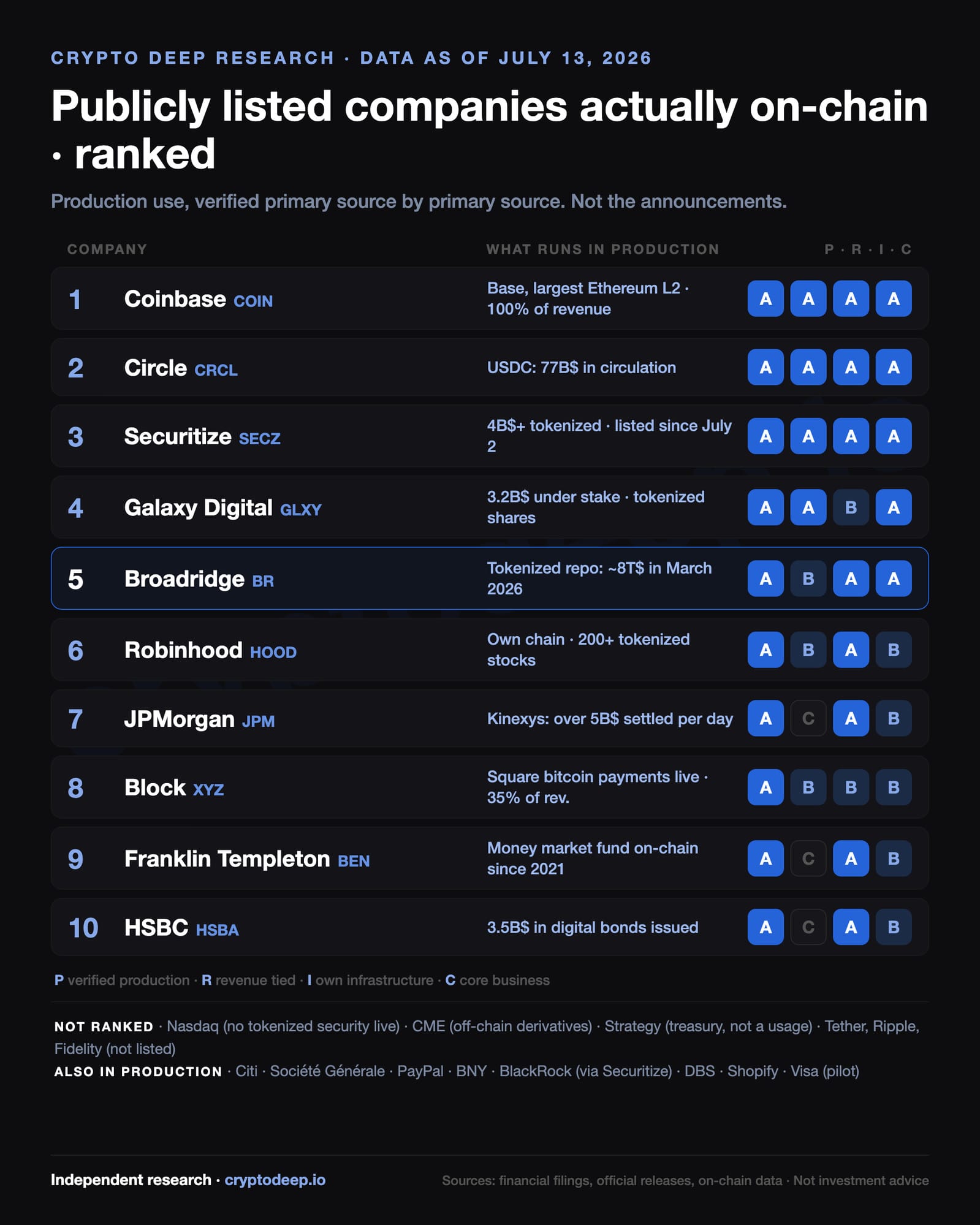
Four criteria, graded A to C. Production (a live system with dated volumes, not a pilot or a press release). Revenue materially tied to the activity. Owned infrastructure (a chain, custody, or tokenization stack the company controls). And depth, meaning core business versus side initiative.
One rule settles most of the noise: holding is not using. A bitcoin treasury, however large, is not an on-chain business. It buys the asset and stores it. That excludes Strategy from any usage ranking. Tether, Ripple, and Fidelity are out too, for a simpler reason: they are not publicly listed.
The biggest on-chain operator is not a crypto company
The top of the list holds few surprises. Coinbase runs Base, the largest Ethereum layer 2 by total value locked, around 4.47 billion dollars. Circle reported 77 billion USDC in circulation at the end of the first quarter. Securitize, which reached the NYSE in early July, tokenizes more than 4 billion dollars in assets, including BlackRock's flagship tokenized fund (BUIDL).
The surprise sits in fifth place. According to the figures Broadridge published on April 9, 2026, its DLR platform processed close to 8 trillion dollars of tokenized repo during the single month of March. That is processed volume, short-dated repo rolled over, not a standing balance. But it is real, recurring, and it dwarfs every crypto-native name on the board.
Two banks make the same point. JPMorgan settles more than 5 billion dollars a day on Kinexys, and its JPMD deposit token has traded on a public blockchain since November. Franklin Templeton has kept the official register of an SEC-registered money market fund on a public blockchain since 2021, now close to 2 billion dollars in assets. Robinhood, Block, and HSBC round out the ten.
What the ranking does not say
One caveat matters more than any single line. At the banks on this list, these flows are still marginal in the income statement. The infrastructure is live, the volumes are real, but the revenue tied to them is not yet material. Usage comes first, monetization follows, not the other way around. Reading this ranking as a revenue story would be a mistake.
Who is missing, and why
The absences are as telling as the ranking. Nasdaq won its SEC green light for tokenized trading in March, yet not a single tokenized security trades on it in production today. CME runs one of the largest regulated crypto derivatives books, all of it off-chain, cash-settled. And Strategy holds 843,775 BTC. Impressive, and beside the point. None of it is a blockchain in use.
The line worth watching is the one between announcing a blockchain and running one. On one side, a release and a roadmap. On the other, a live system with dated volumes and a primary source behind it. This ranking only counts the second kind.
FAQ
Which public companies actually use a blockchain in production?
As of July 2026, verified on primary sources: Coinbase, Circle, Securitize, Galaxy Digital, Broadridge, Robinhood, JPMorgan, Block, Franklin Templeton, and HSBC lead. Each runs a live system with dated volumes, not a pilot or an announcement.
Is Strategy (formerly MicroStrategy) an on-chain company?
No. Its 843,775 BTC held as of July 12, 2026 is a treasury position, not an operational on-chain business. Holding an asset is not using a blockchain.
Which listed company processes the most value on a blockchain?
Broadridge. Its DLR platform processed close to 8 trillion dollars of tokenized repo in March 2026 alone. That figure is processed volume, not a standing balance.
What is the difference between using a blockchain and announcing one?
Production means a live system with dated volumes and a primary source. An announcement is a release, a pilot, or a sandbox with a timeline attached. The gap between the two is the entire point of this ranking.
Article satellite EN · test format récurrent · tag deep-news · public full-crawlable · pas de paywall · 13/07/2026
Member discussion